Poppi: Marketing Done Right
Before doing any research about the soft drinks industry, here is what I know:
- The same players have dominated the market for a long time.
- The media landscape is primarily occupied by the Coca-Cola vs Pepsi debate.
- What space is left in the media is allocated to conversations about a sugar tax.
This last point is the most important, because it means there is demand for healthier options in the soft drinks industry. Which is where my next brand sits — Poppi.
In this series of brands in competitive markets, I have chosen Poppi as the next brand because it has recently been introduced to UK shops, after massive success in the states.
It is no secret that Poppi’s reason for success is their social media. Therefore, in this blog I want to understand how they have harnessed the power of social media to succeed.
Poppi:
In Texas 2015, Allison Ellsworth went to work in her kitchen to find a healthier option for soft drinks without losing the flavour. This resulted in Poppi!
Poppi is not doing anything new. Their flavours include root beer, lemon lime and even classic cola. Simply, Poppi offers a healthier version of these flavours. Each can includes only 5grams of sugar, prebiotics and natural caffeine. The entire can has no sodium, protein or fat, equalling about 30 calories.
The brand was able to really take off after a $400,000 investment from Shark Tank in 2018. Since then Poppi has exploded, becoming Amazon’s number 1 soda in 2023, displaying their first Super Bowl commercial in 2024, and being acquired by PepsiCo in 2025.
The soft drink industry:
The soft drink industry in the US has 3 main players:
- The Coca-Cola Company — US market share 42.4%
- PepsiCo — US market share 27.4%
- Keurig Dr Pepper — US market share 23.1%

According to these statistics by The Guardian in 2021, the US soft drink industry is practically dominated by these three companies. Every other company are left scrambling for 7.1% market share. Of course Poppi has now been acquired by PepsiCo, however this wasn’t a $1.95 billion acquisition for no reason.
Although, similarly to the chocolate industry, the US soft drink industry has a projected CAGR of 7.5% from 2024 to 2030. Paired with rising obesity concerns and regulatory oversight, there is room for new brands offering low sugar alternatives and natural ingredients. Thus, there is no question on whether there is demand for Poppi. Instead, I want to know how Poppi broke through the noise created by the three main companies and gained recognition.
TikTok extraordinaires:
This is the story of how one woman turned a global pandemic into her advantage. Originally, Poppi was called Mother Beverage. Then, the company rebranded, launching nationally on 3rd March 2020 as Poppi. I don’t know about you, but hearing the words March 2020 still fills me with a bit of dread. I have no doubt that Ellsworth was feeling all kinds of dread launching Poppi, knowing there was no possibility for traditional marketing.
As a result, Ellsworth turned to TikTok to promote Poppi. The first videos were completely authentic, sharing how Poppi was born from simply wanting something a bit healthier, to Shark Tank, to launching a brand in the middle of a global pandemic. This method paid off incredibly well, as Ellsworth went viral with billions of views.
Poppi has continued with this digital first approach because it has allowed Poppi to keep up with trends that appeal to their Gen Z and millennial audience. Furthermore, the brand spends time and energy connecting with their online community, responding to posts which builds community. Consequently, Poppi has built a cult following on social media. This sells soft drinks!
Poppi also creates excitement for the brand through exclusive merch and collaborations. Moreover, Poppi utilises celebrity and cultural moments, such as advertising at the Super Bowl and having investors like Kylie Jenner.
Ellsworth also credits Poppi’s success to professionalising and hiring quickly, instead of acting like a start up for a long period of time.
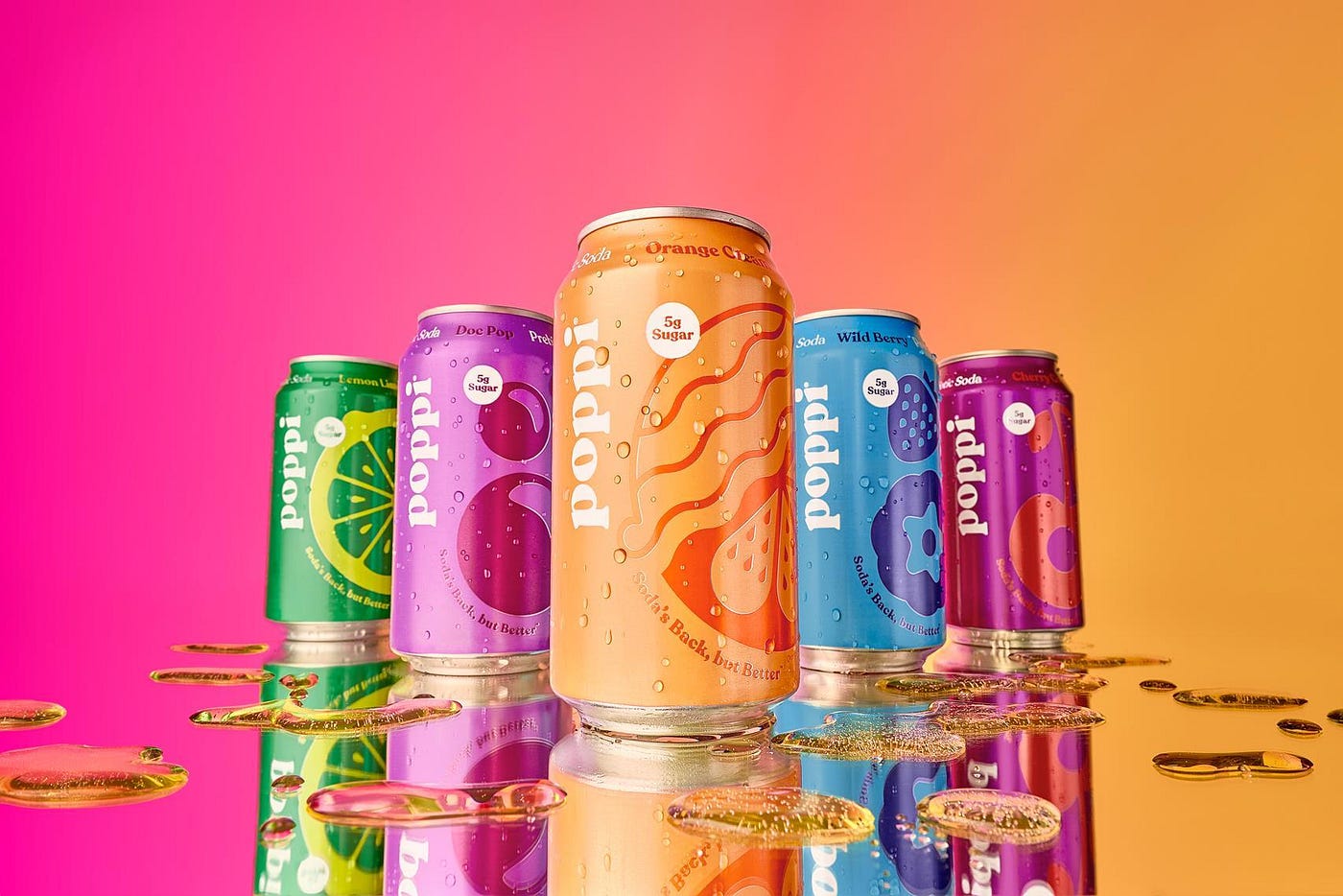
Personally, I am a fan of Poppi’s vibrant branding. The bold colours immediately stand out against the array of beverages on a crowded shelf. Importantly, the branding is fun! It combines a futuristic and 80s nostalgic vibe, and it is unashamedly loud.
Poppi’s social media strategy:
I’ve noted above that Ellsworth began with authenticity in her videos, which is part of the reason the brand went viral. This is something large brands are desperately trying to replicate. Since audiences value authenticity, especially in this age of AI.
By understanding how to attract audiences on social media, Poppi has built a community. This is because on social media ads which are clearly ads don’t build communities. Alternatively, Poppi’s social media posts trends, founder stories, and relatable memes. These posts build familiarity, trust and transparency.
Poppi continues to be an accessible, human brand by using relatable humour in their posts. Not only is this humour fun, which is so on brand, but it humanises the brand allowing them to relate to their customers. Therefore, growing their online community further.
Furthermore, Poppi understands their target audience. Embracing celebrity culture has extended to Poppi’s social media. Poppi has conducted paid partnerships with celebrities like Olivia Rodrigo, a Gen Z favourite. Although this is not ground breaking marketing, Poppi has strategically aligned these partnerships with their wider campaigns, such as their Super Bowl ads. As a result, brand awareness increases and a consistent experience builds trust among consumers.
Something that is unique to Poppi is the aesthetics of their social media feed. Every 12 posts on Poppi’s social media are the same colour. This is incredibly visually appealing and playful, enhancing the consumer experience. Moreover, it replicates Poppi’s in-store displays which utilise colour blocking by showcasing their different coloured cans that’s signify each different flavour (like the picture below). Again, this consistent branding creates trust for consumers as the brand is perceived as more reliable and professional.

Overall, Poppi are forward thinkers. Ellsworth leveraged TikTok before most brands knew how to create a video. By continuing this strategy, Poppi are able to understand what their target market wants and how to capture their attention. Thus, Poppi has become a first class example of how to play the social media game.

Comments
Post a Comment